Apple Podcasts
 Spotify
 PocketCasts
 Summer Is Ending, But the Best RV Camping Is Just Beginning

Fall may be the best RV camping season of the year, but it is no longer a well-kept secret. October campsites are filling quickly as Halloween weekends, fall foliage trips and seasonal festivals turn autumn into one of camping's busiest seasons.
In Episode 634 of the RV Podcast, Stories from the Road, Mike and Jennifer explain why RVers should make the pivot from summer to fall camping right now. They share strategies for finding campsites after popular weekends appear sold out, including booking Sunday through Thursday, calling campgrounds directly about cancellations and using fall foliage prediction maps to better time your trip.
You will also hear about memorable fall destinations and events across the country, from Tawas Point State Park and the Great Smoky Mountains to the Albuquerque Balloon Fiesta, cranberry harvests, giant pumpkin competitions and even racing woolly worms.
Fall camping brings cooler nights, fewer bugs, beautiful scenery and some of the year's most enjoyable RV travel. But if you want a good campsite, the time to make your reservation is today.
Find all the dates, destinations and helpful links by the transcript tab above:
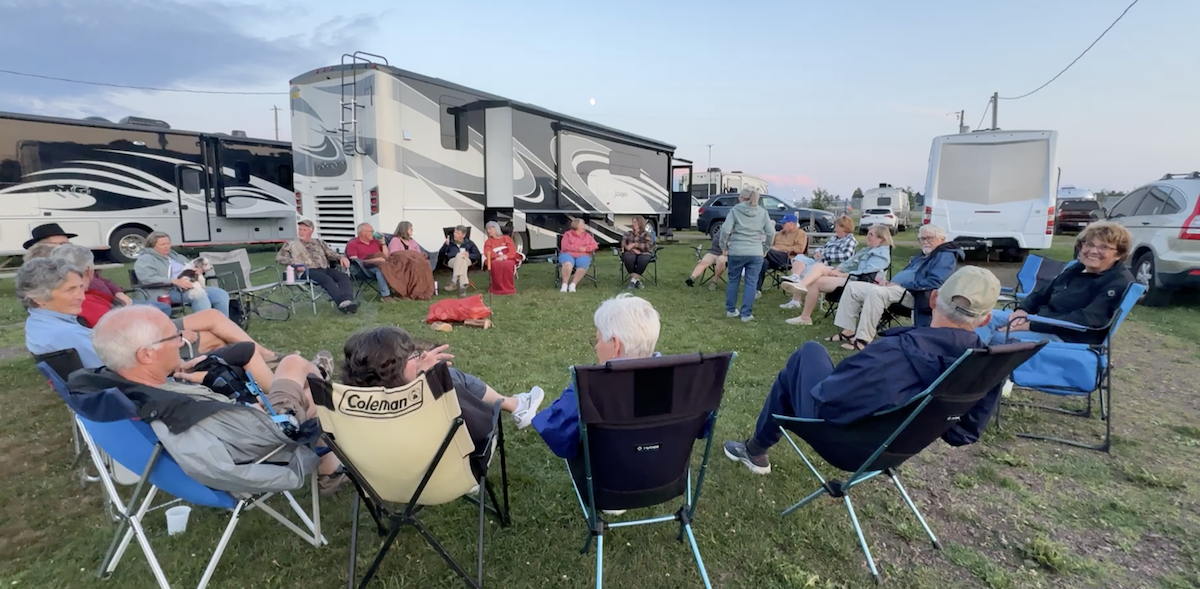
Become a part of the Internet's Best RV Community
Private. Ad Free. No Facebook Nastiness.
RV Travel Tips, Rallies and Meet-Ups, interactive livestreams, exclusive workshops, perks, discounts and Real Help from Real Rvers.
RV Podcast Stories from the Road - August 12, 2026
Show Notes for Episode #634 of The RV Podcast:
Summer Is Ending, But the Best RV Camping Is Just Beginning
This is Episode #634 of the RV Podcast.
And this week on the podcast:
(MIKE): "It's my favorite time of the whole year. Sweatshirt in the morning, shorts by noon, and a fire going by nine."
(JENNIFER): "Everybody's still thinking about summer. Meanwhile the good fall sites are going, right now, this week."
MIKE: In this episode’s conversation, we’ll talk about why October is the Hardest Month to Get a Campsite and help you pivot from summer camping to fall camping which, in our book, is hands down the best time of the year for RVers. .
JENNIFER: We’ll share inside tips on where to go and how you can snag those Coveted fall spots, suggest some awesome things to see we bet you never heard of, answer your RV Questions and much more.
MIKE: Hello everybody and Welcome to the RV Podcast. I'm Mike Wendland, and this is my co-host, my lifelong traveling companion and my bride - Jennifer. Hello, My Dear.
JENNIFER: Hello, My Michael, and this is the RV Podcast, Stories from the Road edition. Fair warning: today's episode is loaded with dates, links, and places you are going to want to write down. Do not try. It is all at RVPodcast.com, under the transcript tab, and in the description below.
And remember, we release two episodes every week. This edition, Stories from the Road, focuses on the RV lifestyle, the people, places, and experiences that make life on wheels so special. Then every Monday, we bring you our RV News edition, covering the biggest stories of the week that impact your travels.
Hershey is September 16 to 20, 2026 at the Giant Center. 57th annual, roughly 1,500 RVs from 40 manufacturers. Watch out: a few manufacturer pages still list September 10 to 14, which is stale. The official show site and PRVCA both say the 16th through the 20th.

CHIT CHAT
MIKE: Before we get into today's conversation, Jen, we have to say thank you for the response to Saturday's video.
JENNIFER: I know. I was not expecting that.
MIKE: We put up the video on YouTube Saturday about Jennifer's recovery from knee replacement surgery, and the comments came in all weekend. People sharing their own surgeries, their own timelines, what worked for them, what nobody warned them about.
JENNIFER: And a lot of just plain encouragement, which honestly meant more than the advice. When you are in the middle of the hard part of a recovery, it helps to hear from people who came out the other side of it and are back out on the road. So thank you. I read all of them.
MIKE: We will keep you posted on how it is going. Now, looking ahead a few weeks, the whole industry is pointed at one thing right now, and that is Hershey. America's Largest RV Show, September 16th through the 20th at the Giant Center in Hershey, Pennsylvania. It is the 57th year, and they will have around 1,500 RVs on the grounds from 40 different manufacturers.
JENNIFER: Which is a lot of walking.
MIKE: It is 33 football fields worth. Wear real shoes. But here is why this year is different, and it ties into what we covered in Monday's news edition. New RV shipments have been way down, dealers are sitting on 2026 inventory they need to move, and a lot of that inventory is going to be at Hershey right alongside the new 2027 models.
JENNIFER: So if you have been waiting to buy, this is the year to walk that show. And if you can't make hershey, a whale bunch of regional shows start up next month, too. Find one near you. We list them in the free newsletter we send out at rvlifestyle.com/newsletter
MIKE: And speaking of getting ready for a trip, like the fall trave we’re about to suggest, we have a recommendation for you for you. Our RV Lifestyle Road Journal. It is a digital travel diary built for RVers, so you can keep track of where you have been, what you saw, who you met, and the little details you swear you will remember and never do. Works all devices. Instant download. Really helpful. Take a look at RVLifestyle.com/journal.
JENNIFER: Alright. Let's get to today's conversation.
CONVERSATION OF THE WEEK: THE LATE AUGUST PIVOT TO FALL
MIKE: It's the second week of August. The kids are heading back to school, the campgrounds are starting to thin out on weeknights, and most RVers we talk to are in a kind of end-of-summer slump. That's exactly the wrong mood, because the best camping of the year hasn't happened yet.
JENNIFER: And the planning window for it is closing right now. That's really what we want to talk about today. Not fall in general, but what you should be doing about fall this week.
MIKE: So let's start with the part that surprises people who haven't done it. Fall camping is not a quieter version of summer camping. In a lot of places it's busier.
PART ONE: HALLOWEEN TOOK OVER OCTOBER
JENNIFER: Mike, tell people what October looks like at a family campground now, because I don't think folks who camp mostly in the summer have any idea.
MIKE: It's Halloween. Not Halloween night. The whole month. Many private campgrounds now run Halloween themed weekends every single weekend in October, and a lot of them start in late September and run into the first weekend of November.
JENNIFER: And it's not a token thing. People decorate their sites like they decorate their houses. Orange lights strung around the awning, inflatable ghosts, cobwebs on the picnic table, fog machines. Some folks pull a second trailer just for the decorations.
MIKE: Jellystone Park says some of their locations run as many as six straight Halloween themed weekends, and that September and October are among their busiest weekends of the entire year. They franchise more than 75 locations. KOA runs Halloween weekends at a large share of their campgrounds too. Independent parks have picked it up. This is now a real season, not a novelty.
JENNIFER: So what actually happens on those weekends?
MIKE: Site decorating contests, and people take them seriously. Costume contests, usually separate ones for kids, adults, and pets. Trick or treating through the campground, where you sit at your site and hand out candy to every kid in the park. Pumpkin carving and painting. Haunted trails, usually with a not-so-scary version for the little ones and a genuinely scary version after dark. Candy bar bingo. Outdoor movie nights.
JENNIFER: And the hayrides. Tell them about the hayrides.
MIKE: A tractor pulling a flatbed wagon full of straw bales and about thirty people in costume, going in a big loop around the campground after dark. Everybody's laughing, kids are screaming at whatever's jumping out of the treeline, and half the adults are holding a cup of cider. It is a genuinely good time and it does not matter how old you are.
JENNIFER: Bring candy. That's the thing nobody tells first timers. If your site is on the trick or treat route, and it probably is, you are going to have a couple hundred kids come by. Buy more than you think you need.
MIKE: Now here's the practical part, and this is the reason we wanted to lead with this. These weekends are hard to get into. Some parks have had people booking a year in advance. If you're hearing this in August and thinking you'll figure out October later, you may already be too late for a Friday or Saturday night at a popular park.
JENNIFER: But there's a workaround, and it's the same one we use all year. Book Sunday afternoon through Thursday.
MIKE: Right. The crunch is Thursday, Friday, and Saturday nights. That's when the weekend crowd comes in, and that's what sells out first at the Halloween parks. Sunday afternoon through Thursday morning, availability opens way up, and rates are often lower.
JENNIFER: And you still get the whole experience. Most of these parks decorate for the entire month and leave it up. So you roll in Sunday afternoon, and the park is still dressed like a haunted village, the pumpkins are still out, and there are maybe fifteen rigs in a hundred site campground instead of a hundred.
MIKE: You lose the organized activities, which is a real trade. If you've got grandkids with you and they want the costume contest and the hayride, you need the weekend. If it's just the two of you, midweek in October is one of the best deals in camping.
JENNIFER: One more tip. If your heart is set on a specific weekend at a specific park, call them directly instead of just checking the website. Cancellations happen, and the front desk often knows about them before the reservation system updates.
MIKE: Okay, the second thing we want to give you today is the tool. Because the number one fall camping mistake is showing up a week early or a week late.
JENNIFER: Which we have done. More than once.
MIKE: More than once. There's a fall foliage prediction map that has been around since 2013 and it's the one we use. It's at SmokyMountains.com/fall-foliage-map. It's free, there's no app to install, it works fine on your phone browser, and it covers the entire lower 48.
JENNIFER: How it works is there's a slider at the bottom. You drag it week by week through the season, and the map shows you where the color is predicted to be starting, near peak, at peak, and past peak. So you can look at the second week of October and see exactly which part of the country to aim for.
MIKE: They build it from historical temperature and precipitation, forecast temperature and precipitation, what tree species grow in each area, and reports from users on the ground. It gets updated through the season as real conditions come in.
JENNIFER: And don't forget official government or state tourism office pages. Michigan, Vermont, New Hampshire, North Carolina, and Tennessee all publish weekly reports during the season.
MIKE: But understand this. No prediction map is going to be perfect. One hard rain with wind at the wrong moment can strip a hillside in an afternoon. Use the map to pick your week, then give yourself a couple of days of slack on either side.
JENNIFER: Which is easier to do in the fall anyway, because you're not fighting for sites the way you are in July.
MIKE: This really Is my favorite season? If I could only camp two months a year I'd pick September and October and not think twice.
JENNIFER: Its the weather, for me. There's a stretch in September and early October in the northern half of the country where you wake up and it's 45 degrees and you need a sweatshirt and your coffee tastes better than it has any right to. And then by lunch it's 72 and sunny and you're in shorts.
MIKE: Sweatshirt and shorts at the same time. That's the whole season in one image. And the bugs are gone. No mosquitoes at dusk, no gnats in your face on the trail.
JENNIFER: The campgrounds change character too. In July everybody is on top of each other and there's a generator running somewhere. In October the sites around you are empty, people say hello instead of just nodding, and it's quiet by nine.
MIKE: Then there's the part I look forward to all year, which is the fireplace. We've got the electric fireplace in the Brinkley, and there is nothing better than a cold clear night with that thing going and a book.
JENNIFER: And here's a practical piece of that people miss. Early fall is the sweet spot for your utility costs, because it's cool but it isn't cold. When the overnight lows are in the 40s and 50s, you don't need to run the furnace and burn propane. You can take the chill off with the heat pump in the bedroom air conditioner instead, running on shore power.
MIKE: Most RV air conditioners with a heat pump function work down to roughly 40 to 45 degrees outside. Below that, there's not enough heat in the outside air for the unit to pull in, and it either kicks over to your furnace or just runs without warming anything. So it's not a winter solution.
JENNIFER: But in September and early October, in a lot of the country, it's exactly right. We'll go a whole two week trip in the fall and barely touch the propane, where in the same rig in November we'd be filling a tank.
MIKE: Check your specific unit before you count on it, because not every rooftop air conditioner has a heat pump. If yours does, there's a heat setting on the thermostat. If it doesn't, you're on the furnace.
JENNIFER: And keep the fresh water tank in mind once you get into late October up north. A hard freeze overnight will get your city water hose before it gets anything else. Disconnect it and run off the tank on cold nights.
MIKE: Let's talk about one specific spot, because it's a favorite of ours and it makes the case for fall better than anything I can say in the abstract.
JENNIFER: Tawas Point State Park, in Michigan.
MIKE: East Tawas, up on the Lake Huron side, about two and a half hours north of Detroit. The park sits out on the end of a sand spit that curls into Tawas Bay. 183 acres. It has been called the Cape Cod of the Midwest, and once you're standing out on the point you understand why. Sand, water on both sides, a Victorian era lighthouse from 1876, and a lot of sky.
JENNIFER: And it's a modern campground, hookups, a dump station, real bathhouses. It's not roughing it.
MIKE: The reason birders know Tawas Point is that it sits right on the Lake Huron flyway, and the shape of the peninsula funnels migrating birds out toward the tip, where they pile up before they continue on. Ornithologists call that a migrant trap. It's considered the most important one in the whole Saginaw Bay area, and something like 300 species have been recorded in and around the park.
JENNIFER: Most people know it for the spring migration, because there's a big birding festival there in May. But the fall migration is every bit as good, and almost nobody talks about it.
MIKE: Fall is raptors and shorebirds moving through, roughly August into October. Watch the Lake Huron side of the point for shorebirds and the bay side for waterfowl. Birding is best right after a strong north wind, because that's what pushes birds down onto the point.
JENNIFER: And there's the monarchs. They’re arriving soon. The monarch butterflies stack up on the point to rest before they head for Mexico. You can be standing there with hundreds of them around you.
MIKE: The lighthouse stays open for tours through mid October, so you can climb the tower and look out over the whole thing with the color coming in behind you. And here's the part that matters for planning: campground availability at Tawas Point actually improves in the fall. In July it's a fight. In late September and October you can get a site.
JENNIFER: And that's really the point of bringing it up. Tawas is our example, but almost every region has one. A coastal spit, a peninsula, a ridge line where the birds funnel through in fall.
MIKE: Hawk Mountain in Pennsylvania. Cape May in New Jersey. Whitefish Point up in Michigan's Upper Peninsula. Point Pelee across the border in Ontario. Find the one nearest to where you're headed and plan a couple of days around it. You do not have to be a birder to enjoy it. You just have to be willing to sit still for twenty minutes.
MIKE: Now let's give people some places to point the rig. Three big ones, and then a couple that are just plain fun.
JENNIFER: Start with the big one.
MIKE: The Albuquerque International Balloon Fiesta. October 3rd through 11th this year, the 54th one. Hundreds of balloons going up at once at dawn over the Rio Grande valley, and the evening glows where they light the envelopes up after dark. This year's theme is the Route 66 centennial.
JENNIFER: They do have on-site RV camping, and it's the best way to see it, because you're right there for the morning mass ascension without fighting traffic in the dark.
MIKE: But be realistic. On-site RV reservations opened back in January and they go fast. If you're just now thinking about it, plan on next year. Do not count on getting a spot on the field this late. Sites are booked solid all around the area as far away as Santa Fe.
JENNIFER: Second big festival one is the Warrens Cranberry Festival, in Warrens, Wisconsin. September 25th through the 27th, and they bill it as the world's largest cranberry festival.
MIKE: More than 100,000 people come to a town of a few hundred. There are something like 1,300 booths of arts and crafts, flea market, and farm market strung out over about three miles. They run guided bus tours of the working cranberry marshes, which is the part I'd actually go for. The marshes are flooded for harvest and the berries float, so you get an acre of solid red. Sunday at noon there's the largest band parade in Wisconsin.
JENNIFER: And it's free to attend. Third one, Circleville Pumpkin Show in Circleville, Ohio. October 21st through the 24th.
MIKE: They call it the Greatest Free Show on Earth and they've been doing it since 1903. About 400,000 people over four days in a town of 14,000. Seven separate parades. Giant pumpkin weigh-ins, a pumpkin pie eating contest, hog calling, a big wheel race. And everything is pumpkin flavored, and I mean everything, right down to the burgers.
JENNIFER: Free admission there too. Now the fun ones. Again again, we have links to all this under the transcript tab at RVPodcast.com for this episode and, on YouTube, in the description below.
MIKE: The West Virginia Roadkill Cook-Off, in Marlinton. This year it's Saturday, September 26th.
JENNIFER: Explain that name before people turn the podcast off.
MIKE: Fair. It's not actual roadkill. Health regulations apply like any other food event. The rule is that whatever you cook has to be something that could plausibly end up as roadkill. So you get venison, bear, squirrel, turtle, possum, and one year somebody hauled in moose from Colorado. Cooking teams compete, you buy a $10 wristband, and you sample and vote.
JENNIFER: The team names are half the entertainment.
MIKE: Deerly Departed Jambalaya. Asphalt Bambi Chunks. It's about 20,000 people in a small mountain town in Pocahontas County, with an autumn harvest festival, craft vendors, and mountain music going all day. Food Network has come out for it several times.
JENNIFER: And the other one is the Woolly Worm Festival, in Banner Elk, North Carolina. October 17th and 18th, and this is the 49th year.
MIKE: They race caterpillars. Woolly bear caterpillars, up a three foot piece of string, heat after heat, all day Saturday and Sunday.
JENNIFER: And the winner predicts the winter.
MIKE: That's the whole premise. Mountain folklore says the 13 bands on a woolly worm correspond to the 13 weeks of winter, dark bands are cold weeks and light bands are mild ones. Problem is every caterpillar has different bands, so back in 1978 somebody decided the only fair way to pick the official forecaster was to race them. Saturday's winner takes $1,000 and gets to make the call for the North Carolina High Country.
JENNIFER: Around 20,000 people show up. There are 175 or so craft vendors. And it lands on the traditional peak color weekend for that part of the Blue Ridge, which is not an accident.
MIKE: So there's your excuse to be in the mountains that week.
JENNIFER: Let's close by walking through the regions, because fall doesn't happen everywhere at once and that's the advantage. You can chase it for two months.
MIKE: Start with ours, the Smokies, because that's where we're headed. We'll be at the RV Community rally in Pigeon Forge this fall.
MIKE: This is one of our numerous members-only rallies and Meet-Ups that we hold at RVCommunity.com all year round. It sold out six months ago. But If you haven’t joined RVCommunity.com yet, our rallies and MeetUps are another reason why you should. Check them out at RVCommunity.com We have another one scheduled the first week in December in the Florida keys and lots more all acros the country coming in 2027. Learn more at RVCommunity.com
JENNIFER: I cant wait for the Smokies next month. The color down there is breathtaking.
MIKE: The park has around 100 native tree species, more than most of Europe, and the elevation runs from about 900 feet up to over 6,600. So the color starts up high in mid to late September with the beech and birch, and then walks down the mountain for six or seven weeks. Mid October to early November is the low and middle elevations.
JENNIFER: Which means if you time it wrong, you just drive up or down until you find it. That's a nice thing about the Smokies specifically.
MIKE: New England next, and that's the classic. Northern Maine and the White Mountains go first, usually the last week of September into the first week of October. Vermont peaks roughly late September into the first ten days of October. Southern New England runs later, into mid and late October.
JENNIFER: And Colorado, which is completely different and worth seeing at least once.
MIKE: Colorado isn't reds and oranges. It's aspens, and aspens go one color, a yellow that's almost gold, and they grow in stands so you get whole mountainsides of it at once. Peak in the high country is usually the last two weeks of September, so it's earlier than most people plan for. If you're going, go early.
JENNIFER: And then the one people never think of, which is our answer for late October and November.
MIKE: The Gulf Coast. Specifically the northern Florida panhandle and the Alabama shore. And I will argue with anybody about this: that stretch has the best weather in America in the fall. Hands down.
JENNIFER: The humidity is gone. That's the whole thing. Everything that makes the Gulf Coast miserable in August is just absent by late October.
MIKE: The Gulf water is still warm, because it takes months to give up the summer heat, so you can still swim. The days are clear and warm without being hot. The afternoon thunderstorms that build up every single day all summer stop. And hurricane season is winding down.
JENNIFER: Plus the crowds are gone and the rates drop before the snowbirds arrive in force. There's a window in there, roughly late October into early December, that's close to perfect.
MIKE: So that's the season. Aspens in Colorado in late September, New England the first week of October, the Smokies mid to late October, and then run south to the Gulf for November. That's a two month trip and every leg of it is better than July.
JENNIFER: If you take one thing out of this conversation, make it this: go book something today. Not next month. Today.
MIKE: Book Sunday through Thursday if you want your pick of sites. Pull up SmokyMountains.com/fall-foliage-map, find your week, and work backward from there.
JENNIFER: And if you've got a fall spot you love, tell us. We read every one of these and we're always looking for the next one.
MIKE: Send it through the contact link at RVPodcast.com. We may read yours on a future show.
Sources for show notes:
● Our Newsletter: RVLifestyle.com/newsletter
● RVLifestyle Trip Journal: RVLifestyle.com/journal.
● Fall foliage map: https://smokymountains.com/fall-foliage-map
● Tawas Point State Park: https://www.michigan.org/property/tawas-point-state-park
● Tawas Point birding detail: https://birdinghotspots.org/hotspot/L232597
● Balloon Fiesta: https://www.balloonfiesta.com/rvs/
● Warrens Cranberry Festival: https://www.cranfest.com/
● Circleville Pumpkin Show: https://www.pumpkinshow.com/
● WV Roadkill Cook-Off: https://pccocwv.com/autumn-harvest-festival/
● Woolly Worm Festival: https://woollyworm.com/
● Jellystone Halloween weekends: https://www.campjellystone.com/activities/theme-events/halloween
BREAK - RV Overnights
Hey, if you are like us, you’re getting a little worn out paying top dollar for crowded RV parks
We've talked about this one before, and Jennifer and I keep coming back to it because it just works. And last year we came across something that honestly changed the way we travel. RVOvernights.com .
One of our favorite stays was at a bison ranch in Indiana. Real bison, right outside the RV window. Huge animals. Absolutely incredible. And that's just one example. They've got wineries, farms, museums, even a lavender field. All over the country. Canada, too. Places you'd never find in any campground directory.
And it's really easy to use. Pull up the interactive map, see what's available along your route, book your overnight. Done. No digging around, no guessing.
These aren't random parking lots, either. These are unique, memorable stays hosted by real people all across the US and Canada. And the whole thing is just $49 for an entire year.
Right now they're offering our listeners 40% off with promo code RVLDEAL.
After more than 15 years on the road, we don't recommend something unless we actually use it ourselves. This one we keep coming back to.
Head to RVLifestyle.com/rvovernights and use promo code RVLDEAL to save 40%.
RV QUESTIONS OF THE WEEK
QUESTION FOR JENNIFER: "My husband and I are picking up our first travel trailer next month and everyone keeps warning us about how small it is and how we'll be on top of each other. We've been married 31 years and we get along fine, but honestly the warnings are starting to get in my head. Is living in that little space together as hard as people make it sound?" - Denise, Springfield, Missouri
ANSWER: Denise, I get some version of this question quite oten, and I want to give you a straight answer rather than a reassuring one.
It is not the square footage. That is the thing everybody gets wrong. You are not going to be sitting three feet apart staring at each other. You will be outside most of the day, or driving, or walking around a campground, or in town. The trailer is mostly where you sleep and eat. The actual hours you spend in that small box together are fewer than people imagine.
What is hard, and nobody warns you about this part, is that you lose the ability to be annoyed in private. At home, when your husband does the thing he does, you go to another room for ten minutes and it passes. In a trailer there is no other room. So a small irritation that used to evaporate on its own now has to be either voiced or swallowed, and neither of those is a habit most couples have practiced.
Mike and I hit that in the first month. It was not a fight. It was smaller than a fight, which is exactly why it was hard to deal with.
Three things helped us, and I would pass all three to you.
The first is that we each claimed a place to be alone. Not a room, just a spot. Mine is a chair outside with a book. Mike's is the driver's seat with his laptop. When one of us is in that spot, the other one leaves them alone. It sounds almost too simple, but having a signal that means "I need twenty minutes" and not having to explain it every time takes enormous pressure off.
The second is that we divided up the jobs and stopped renegotiating them. Who backs in, who hooks up water and sewer, who does the inside setup, who handles the checklist. When you have to decide who does what at every single campground, you are having thirty small negotiations a week, and every one of them is a chance to get short with each other.
The third one is that we learned to say the small thing out loud when it is still small. That was the hardest one for me. But the alternative is collecting them, and in 200 square feet, a collection gets heavy fast.
Here is the part I actually want you to hear, though. Thirty-one years in, you already know how to do most of this. The couples who struggle in an RV are usually the ones who were already avoiding something at home and now cannot avoid it anymore. The trailer did not create the problem. It just removed the extra rooms they were using to route around it.
If you two get along fine now, you will get along fine in the trailer. And I will tell you something that surprised me: it made us closer. You solve problems together on the road that you would never encounter at home. You get better at reading each other. Mike can tell from how I set down a coffee cup what kind of morning I am having.
So do not let the warnings get in your head. Go get the trailer. Take a short trip first, three or four nights close to home, and see what comes up. Whatever you learn on that trip is worth more than anything anyone can tell you.
QUESTION: Mike, we've been camping in temperatures in the mid-90s, and our RV air conditioner just can't seem to keep up. It's running constantly. How cool should I realistically expect my RV to get? Is something wrong with it?
ANSWER: That's one of the most common questions I get every summer, and the answer surprises a lot of people.
Most RV rooftop air conditioners are designed to lower the temperature inside your RV by about 18 to 22 degrees below the outside temperature under normal conditions. So if it's 95 degrees outside, a comfortable inside temperature of around 73 to 77 degrees is actually considered normal. If it's 100 degrees outside, don't expect your RV to feel like a meat locker.
There are a lot of factors that affect how well your AC performs. Direct afternoon sun, high humidity, dark-colored RV exteriors, large windows, and even how often you're opening the door all make your air conditioner work harder.
The best thing you can do is help your AC instead of expecting it to do all the work. Start cooling the RV early in the morning before the heat builds. Close the shades or blinds on the sunny side, especially the windshield if you have a motorhome. If you have two air conditioners, run them both before the hottest part of the day. And don't forget the basics, keep the air filter clean and make sure nothing is blocking the return air vents.
One more tip: if you're plugged into 30-amp service, be careful about running the microwave, electric water heater, or other high-draw appliances while the AC is working hard. A tripped breaker won't help anybody stay cool.
Finally, if your RV isn't getting within about 20 degrees of the outside temperature even after running for a while, or if the air coming out of the vents doesn't feel noticeably colder than the air going in, then it's worth having the system checked. You could have low airflow, a dirty evaporator or condenser, damaged ductwork, or another issue that's reducing its efficiency.
Remember, RVs aren't insulated like houses. On the hottest days of summer, setting realistic expectations, and helping your air conditioner out a little, can make a big difference in your comfort.
Have an RV question you'd like me to answer in a future newsletter? Just hit the CONTACT link at RVPodcast.com. I read every email, and your question may appear in an upcoming episode.
Send questions by the CONTACT link at RVPodcast.com.
Thanks so much for listening! If you enjoyed today’s episode, we’d love it if you could take a moment to leave us a kind review on Apple Podcasts, Spotify, or wherever you’re tuning in. Your feedback helps us grow and reach more listeners just like you.
ROLL CREDITS