
 Apple Podcasts
 Spotify
 PocketCasts
 Ticks Are Exploding This Year: The Hidden Disease That Can Make You Allergic to Meat

Ticks are having a banner year across much of North America, and that has outdoor enthusiasts, hikers, campers, and RVers paying close attention.
Most people know about Lyme disease. But far fewer have heard of Alpha-Gal Syndrome, a tick-borne condition that can suddenly make you allergic to red meat and trigger severe, even life-threatening allergic reactions.
In this episode of the RV Podcast, we revisit one of the most important health interviews we've ever done.
RVer Fred Church shares the remarkable story of how a single tick bite changed his life forever. What started as what seemed like food poisoning after eating a hamburger soon turned into a frightening medical mystery involving swelling, vomiting, intense itching, and a diagnosis that left him unable to eat many of the foods he had enjoyed his entire life.
Fred explains how Alpha-Gal Syndrome develops, the symptoms he experienced, how he was diagnosed, and the precautions he and his wife Kathy now take whenever they head outdoors.
The timing of this conversation couldn't be better. Earlier this summer, Mike had a tick embedded in his face that required a dermatologist to make an incision and use two stitches to remove it. The doctor told him he had already removed dozens of ticks from patients this season.
Whether you're exploring hiking trails, walking the dog around the campground, sitting around a campfire, or simply enjoying the outdoors, this episode is a powerful reminder that tick prevention is more important than ever.
If you think the only tick-borne illness you need to worry about is Lyme disease, this conversation may change your mind.
In this episode:
• Fred Church's personal Alpha-Gal Syndrome story
• The symptoms that led to his diagnosis
• How a tick bite can trigger a red meat allergy
• What RVers and outdoor travelers need to know
• Practical tick prevention strategies
• Why tick-borne illnesses are becoming a growing concern
This is one of those episodes that could make a real difference for you, your family, and your travels.
Also in this episode, answers to your questions about:
- Whether a Combo or a separate washer and dryer is best for an RV
and
- How to best learn how to drive an RV
Get the RV Lifestyle Newsletter at https://rvlifestyle.com/newsletter
Become a part of the Internet's Best RV Community
Private. Ad Free. No Facebook Nastiness.
RV Travel Tips, Rallies and Meet-Ups, interactive livestreams, exclusive workshops, perks, discounts and Real Help from Real Rvers.
Unknown Speaker (0:00): This is episode 618 of the RV podcast.
Unknown Speaker (0:04): And this week on the podcast
Fred Church (0:06): Many people do wind up in the ER with true full blown anaphylaxis, and there have been people who die because of this.
Mike Guadelin (0:16): In this episode's conversation of the week, we're going to hear from an RVer whose life was permanently changed by a single tick bite, and we're gonna learn about the little known disease that can make eating a hamburger a medical emergency.
Jennifer (0:30): Plus, we'll share travel tips, answer your RV questions, and much more. This episode is being released on 06/17/2026.
Unknown Speaker (0:39): Hello, everybody, and welcome to the RV podcast. I'm Mike Guadelin, and this is my cohost, my lifelong traveling companion, and my bride, Hello,
Unknown Speaker (0:49): my
Unknown Speaker (0:49): Hello, my Michael.
Unknown Speaker (0:50): You are looking particularly spiff in your rvcommunity.com member, founder, no less founder, polo shirt. Ah. We got uniforms.
Unknown Speaker (1:02): We we got uniforms. Mike is big into shirts and hats and uniforms.
Unknown Speaker (1:07): Hey. We release two episodes of the podcast every week. This one, Stories on the Road, focuses on the RV lifestyle and the people and the places and experiences that make life on wheels so special.
Jennifer (1:18): Then every Monday, we bring you our RV news edition covering the biggest stories of the week that impact your travels.
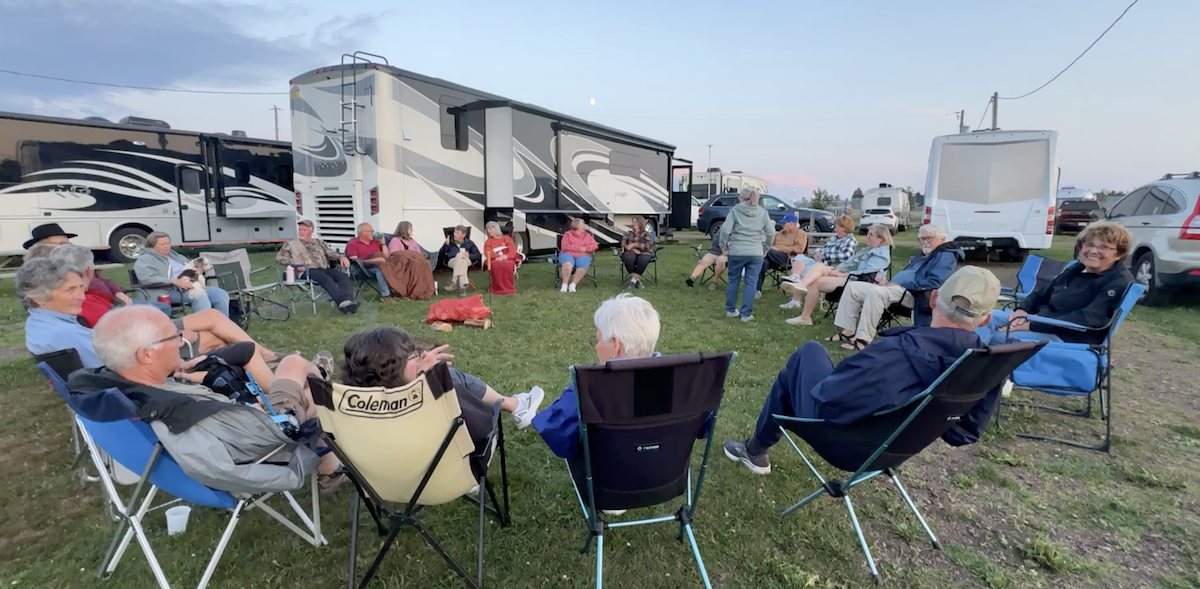
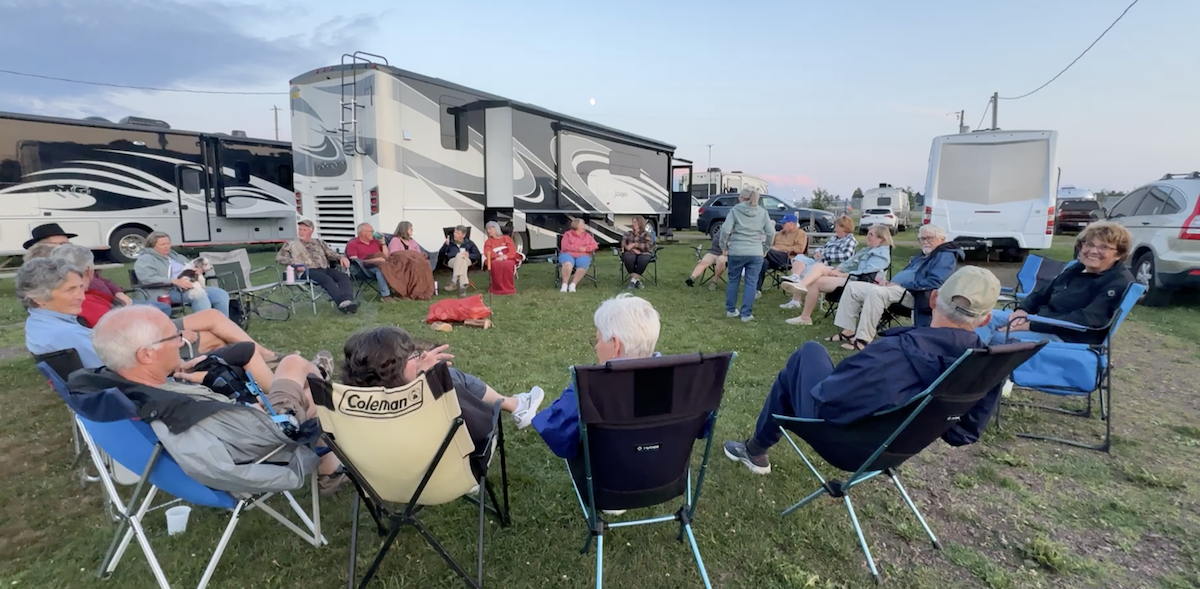
Mike Guadelin (1:25): Well, we're coming to you today from Hocking Hills, Ohio where we're hosting the twenty twenty six summer RV community rally. And we 88 people, I think.
Unknown Speaker (1:38): 88 people. And if you count Phyllis and Wendy and you and me, we get into the nineties.
Unknown Speaker (1:44): And Bo is with us. Bo has mastered a victory over a theory he had about riding in a golf cart.
Unknown Speaker (1:54): I'm proud of him. He conquered a fear.
Unknown Speaker (1:56): He conquered a fear.
Unknown Speaker (1:57): And I even got a lesson in how to drive a golf cart.
Unknown Speaker (2:00): You know, a lot of people don't know about Hocking Hills outside of the Midwest, and it is really one of the places that belong in every RVers bucket list. It's just fabulous. Our people are hiking trails, exploring caves. They're doing long e bike rides. There's a great state park here.
Unknown Speaker (2:21): There's lakes. We're kayaking, canoeing, and lots of socializing. But if even if you're not a member of our community, you come. This is just an awesome place.
Unknown Speaker (2:31): How could you forget the pencil museum?
Unknown Speaker (2:33): Oh my
Unknown Speaker (2:33): gosh. Yeah. There is the world famous pencil museum right here in Logan, Ohio. You'll sleep after a long day of touring that, which I think takes about five minutes.
Unknown Speaker (2:45): Maybe thirty seconds? No. I'm just joking.
Unknown Speaker (2:48): Anyway, it's an awesome area. If you've never been to Hawking Hills, take a look at it. We are really pleased with this is a choice for a rally, and we've had a great time this week. We invite you to come and check it on your own, or come join rvcommunity.com and attend one of our rallies. We have three of them every single year.
Unknown Speaker (3:07): Hey. Real quick. You know the thing where you get two hours down the road and you suddenly remember that you to pack something? It's happened to us.
Unknown Speaker (3:16): It sure has more than once.
Mike Guadelin (3:18): Well, we spent all these years that we've been doing this refining what we think is a way that that won't happen with us anymore. And it's a packing system that actually works for RV travel. We turned it into a web app. It's called the ultimate packing list tool. How's that for being original?
Mike Guadelin (3:36): Every single category you would actually need as an RVer is already built in. Kitchen, bedroom tools, safety gear, outdoor equipment, documents, stuff about your pets.
Jennifer (3:47): You customize it to your rig, check things off as you pack, and when the trip is over, you just reset it for next time. No reentering everything. No starting from scratch. Works on your phone right there at the rig. It's a $9.95 instant access.
Jennifer (4:06): No subscription. No app store. Find it at rzlifestyle.com/packing list app and we'll put the link to it in the show notes below.
Unknown Speaker (4:14): You can put it on your phone, by the way, your tablets, your laptop, anything you want. Once you log in, set up an account. When you purchase it, it works on all your devices. Really cool. Anyway, check it out.
Mike Guadelin (4:28): List is in the show notes. Alright. Time now for the conversation of the week.
Jennifer (4:33): You know, ticks are everywhere this year. You don't have to look very hard to find stories about exploding tick population and growing concerns about tick borne illnesses and warnings from health officials about spending time outdoors.
Mike Guadelin (4:48): Most of us know about Lyme disease, but there's another tick borne illness that's spreading rapidly and can completely change your life. It's called alpha gal syndrome. Weird name. Terrible disease. Ticks, by the way, have become so bad this season that I had one attach itself right here to my face while we were out enjoying the outdoors.
Mike Guadelin (5:09): And when I went to my dermatologist to have it removed, he told me he'd already removed about 30 ticks from patients so far in the season. And mine was embedded deeply enough there that it required a small incision to get it out and, two stitches to close it, and that got my attention.
Jennifer (5:27): And it makes this week's interview especially timely for RVer Fred Church. It all started with what seemed like a simple case of food poisoning after eating the hamburger he became violently ill but shrugged it off as a stomach bug then a month later he had another hamburger and woke up in the middle of the night with intense itching on the palms of his hands and the soles of his feet. His tongue began swelling. He started vomiting. His speech became difficult to understand.
Mike Guadelin (5:56): What followed was the diagnosis changed Fred's life forever. A blood test revealed that Fred had developed alpha gal syndrome, that is very serious allergy triggered by a tick bite. Suddenly, that he'd eaten his entire life like beef and pork, venison, other mammal products could trigger a dangerous allergic reaction. Fred and his wife Kathy are longtime RVers. They love the outdoors, but this experience changed the way they think about tick prevention bug spray, hiking, camping, and spending time outside.
Jennifer (6:31): In a fascinating and eye opening conversation, Fred shares what happened, how he learned the cause, what life is like now, and why every RVer, camper, hiker, and outdoor enthusiast needs to understand the risk.
Mike Guadelin (6:46): We first interviewed Fred last summer, and in light of the explosion of tick borne illnesses being reported this year, we think it needs a replay. I mean, we all know about Lyme disease, but after hearing Fred's story, you're gonna realize there are other tick borne illnesses that may be just as frightening and in some cases, life changing and life threatening. This is one interview every outdoor traveler needs to hear. Fred, let's just start with you. Kinda walk us through this story a little bit.
Unknown Speaker (7:15): How how you got bit by a tick? Let's start with that.
Fred Church (7:19): Honestly, I don't remember where I was to get it. I think I may have been at my daughter's place in North Arkansas where they have five acres, and the dog likes to play in that big yard and the grass is tall, but I fish a lot. It may have been that way. But I got a tick bite June '24, may have been May, and it was on my back. And it was there for a day or so because I couldn't see it being on my back.
Fred Church (7:50): And then I realized something was there. Had my wife look at it, she goes, oh, yeah. There's a tick. So she got it off. Didn't think that much about it other than it then started to itch.
Fred Church (8:02): And I don't think the itching has much to do with the syndrome, but that's why I remember the tick bite. It itched for weeks. And that was it. Didn't think much about it. And then I'm not a big beef eater anyway.
Fred Church (8:20): But one day, we decided to go to lunch and I got a hamburger. It tasted great. I hadn't had a hamburger in a long time. And that night, about maybe 06:00, we were just about ready to eat and I just looked at her and I stood up and went to the bathroom and just threw up and threw up and threw up. Yet when I finished, I felt great.
Fred Church (8:44): I mean, I didn't feel sick. It was just it was gone and I thought, well, I got a bad hamburger. And apparently, that is just very classic for people's first reaction.
Unknown Speaker (8:58): Why do they call it alpha gal?
Fred Church (9:01): Well, it's a it's a allergic reaction to a sugar that is alpha galact ose. And I'd I'd heard of it. I kinda knew generally about it before I had it. We have a friend who has it, but I didn't know anything really. And apparently, all mammals have the sugar, alpha galactose, except humans.
Fred Church (9:27): And that's the reason it becomes a problem if you acquire it.
Unknown Speaker (9:33): So you came down with this. Now you got sick. You just thought that first time was bad burger, food poisoning. Oh, how did we drill down a little bit more and find out
Fred Church (9:44): Well, about two months later, it was time for another burger. Got a burger, and this time it was at night or in the evening. And about 01:00 in the morning, I woke up because my tongue was itching so intensely that it woke me up. And then I realized my palms were itching, and the soles of my feet were itching. And that's a pretty good allergy when that starts.
Fred Church (10:11): And then I so I get up and trying not to disturb my wife, realize go to kitchen and realize my tongue is swelling. And by the time I got to work in, it sounded like I was really drunk. I got her up because I thought, you know, if it gets any worse than this, we're going to the ER. Unfortunately, the ER was, like, two or three blocks away, so it wasn't like it was gonna be a terrible something. It was tear it would have been terrible, but wasn't gonna be a thirty minute ride.
Fred Church (10:41): Got some Benadryl in me. Actually, I threw up again and, got some Benadryl in me after that. And that's when I started kinda putting two and two together.
Unknown Speaker (10:52): You had not been did you did not go to the ER that night?
Unknown Speaker (10:56): No. I did not.
Unknown Speaker (10:57): So you took some Benadryl, felt better, knew it was an
Fred Church (11:00): allergic reaction. It never got to my airway. My tongue was swollen really quite a bit, but I could breathe fine. Right. And then with the Benadryl over the next three or four hours, it kinda went back to a normal tongue and I quit itching.
Unknown Speaker (11:15): How But I knew something was up.
Unknown Speaker (11:17): So how did you, how did you ever get diagnosed and figure this out?
Fred Church (11:22): Well, basically, I started with the Internet, looked it up on Google, and realized that my reaction, both of them, was very classic. Most people most people will start with a food poisoning like reaction and not think very much of it. And then their next one is the one that starts to get pretty big. And mine was actually fairly minor compared to many people's. Many people do wind up in the ER with true full blown anaphylaxis.
Fred Church (11:51): And there have been people who die because of this.
Unknown Speaker (11:55): So this is not something just to take for lightly that, oh, well, I got this little condition. What else besides beef are you restricted? Is it any other foods?
Unknown Speaker (12:06): We're also test
Fred Church (12:08): Let me yeah. One thing I will throw back in about getting diagnosed. After reading about it on the Internet, I had some blood work run for the IgE components of this disease, and everything was elevated. And I had pretty classic reaction there too. It boils down to really pretty simple.
Fred Church (12:28): If, if meat has hair or fur, I shouldn't eat it. If it has feathers and scales, I'm okay, which limits you a lot.
Unknown Speaker (12:41): Now you have a medical background as is your wife. You are retired periodontist. Your wife, a retired physician. With your medical background, what has surprised you about about this?
Fred Church (12:56): I think the thing that surprises everybody is the fact that it's such a delayed reaction. Typically, when you have an allergic reaction, as it gets into your system, you pretty quickly have a reaction. Like, if you take an amoxicillin and you're allergic to penicillin, probably within fifteen or twenty minutes, you're gonna start having something. This is hours. Average is four.
Fred Church (13:20): Mine was closer to six. So that throws off most people's instinct on what's an allergy or what you're gonna be allergic to because you you're sitting there going, what did you have? And you're not going far enough back time wise to think about it.
Unknown Speaker (13:38): Now there are so many ticks out there, different types of ticks. We all certainly know about Lyme disease, and there are others. I'm willing to bet that you've become kind of an expert in ticks and, tick borne diseases from all of this.
Fred Church (13:53): I know to be very careful. I'm I'm much more careful when I'm out now, mostly because nobody really knows if it lasts forever or not. But they do know that if you continue to be bitten, it tends to be the lone star tick that's a type of tick. It's not the only one, but that's the primary one that carries this. And if if you're bitten again, it just starts the whole process over, and you may not ever get over it.
Fred Church (14:25): So I'm being real careful. But the suggestion is two years after your bite to be completely retested to see where you are. And by then, I may be okay, and it may still be just like it is. It it's a total crapshoot.
Unknown Speaker (14:41): Now our folks, course, who, follow us here in this podcast, they're active. They're outside a lot, with, the RV lifestyle. Some advice for people. Ticks are now everywhere.
Fred Church (14:55): They really are. Obviously, you know, be aware of them. They're mostly gonna be in tall grass. I tend to wear long pants now when normally I would have worn shorts, and I just about don't do that anymore. They make I don't have any, but they make clothing that has been immersed in special chemicals that really repel them.
Fred Church (15:19): I don't I hadn't gotten to that point, but I do really spray my feet, socks, pants very heavily with just a good bug repellent with DEET. One of the one of the things I saw recently, which makes a lot of sense is to take duct tape, reverse it, and put the sticky side out and roll it around your pants legs at your socks to kinda compress them. And it kinda traps the tick on the way up.
Mike Guadelin (15:48): Lots of theories about why they are so prevalent now, how all these have happened in relatively recent years, but, no doubt that ticks are now pretty much, all over the 48 states. And, that's good. Well, Fred, thank you for sharing your story. That's a part of a disease that most of us would be unaware of. We don't like ticks, but I don't think, as somebody who likes burgers, I don't think I need this one either.
Fred Church (16:17): It's been it's been a game changer. Yep. It is. It's the number one reason adults wind up with anaphylaxis right now, which
Unknown Speaker (16:26): is Really?
Fred Church (16:27): Yes. Which is just amazing.
Mike Guadelin (16:30): Wow. You didn't have any trouble with an insure with insurance or anything with, with all this, did you? No. Because we've heard scary stories about people, and maybe that's changed in recent years, people with Lyme disease who could not get insurance coverage. They were very slow in recognizing that as a true problem.
Fred Church (16:50): We we handle that differently in Arkansas. This is sort of a joke, but it's true. There's no Lyme disease in Arkansas because our health department does not test for it. So if you don't test for it, there is none. That is true.
Unknown Speaker (17:06): Wow. Well, that's
Unknown Speaker (17:07): Don't ask me why.
Unknown Speaker (17:09): Yeah. That's that's a big question for Arkansas because they sure Lyme disease sure is everywhere else. Hey, Fred. Thank you. We will pass along some more information about ticks, but, love love hearing getting your story and, great warning for
Fred Church (17:24): just need to know about this. They do.
Unknown Speaker (17:27): Thanks so much for making time for
Unknown Speaker (17:29): Good talking with you.
Mike Guadelin (17:31): Well, there you go. Another reason not to get a tick bite. And it's hard to avoid it. I mean, we've we've seen it now in just about every part of the country. It used to be mostly the East Coast, but now they're everywhere.
Mike Guadelin (17:44): Right?
Unknown Speaker (17:44): They are. Even our home state of Michigan, it used to be they were on the Western side, Northern side of the state, but not the Eastern. Now they're they're everywhere.
Unknown Speaker (17:53): Yeah. And it's like that in every single state we've been at. Alright. Hey. If you're like us, you're getting a little worn out paying top dollar for crowded RV parks.
Jennifer (18:03): We've talked about this one before, and Mike and I keep coming back to it because it just works. And last year, we came across something that honestly changed the way we travel, rvovernights.com.
Mike Guadelin (18:15): One of our favorite stays you remember us talking about was at a bison ranch in Indiana. Real bison right outside the RV window. Huge animals. Absolutely incredible. And that's just one example.
Mike Guadelin (18:27): They've got wineries, farms, museums, even a lavender field all over the country. Canada too. Places you'd never find in in any campground directory.
Jennifer (18:36): And it's really easy to use. Pull up the interactive map, see what's available along your route, book there your overnight, done, no digging around, no guessing. These aren't just random parking lots either. These are unique memorable stays hosted by real people all across The US and Canada, and the whole thing is just $49 for an entire year.
Mike Guadelin (18:58): And right now, they're offering our listeners 40% off if you use the promo code RVL deal. After more than fifteen years on the road, we don't recommend something unless we actually use it ourselves, and this is one we do. Head over to rvlifestyle.com/rvovernights and use the promo code RVL deal to save 40%. Alright. It's time now for questions of the weekend, Jen.
Unknown Speaker (19:25): This one's for you.
Unknown Speaker (19:26): It comes
Mike Guadelin (19:27): from Carolyn who says, my husband and I are thinking about getting a washer and dryer for our fifth wheel. He wants a combo unit, and I'm holding out for separate washer and dryer units, I think you and Mike have. What is your honest recommendation?
Jennifer (19:42): Mike and I have actually been on both sides of this debate, So I can give you a genuine honest answer. We had a combo unit, and now we have separate machines. And I will tell you right now, go with a separate. Here is the thing nobody warned you about with a combo unit. The drying time is just brutal.
Jennifer (20:02): You're taking sometimes three three and a half hours for one load. You throw in a couple of pairs of jeans and some towels and you have basically committed your entire afternoon or evening to laundry. And if you need to do more than one load, you might as well pack a good book because you're not going anywhere. With separate machines, you cut that time in half at least. Wash cycle runs, you move it to the dryer, and you're done in a much shorter amount of time.
Jennifer (20:30): That alone was worth it for me. Now don't get me wrong. Those RV washer and dryers have much smaller capacities than your home machines. Thus, it takes longer to do. The solution is not to wait and do a week's worth like you can at home.
Jennifer (20:46): Do a load every day or every other day then it's reasonable that there are other reasons to go with separate units. Combo units are notoriously hard on clothes over time. The tumbling and the heat cycles together just wear fabrics out faster than separate machines do. And if something goes wrong with a combo unit, you've lost both your washer and your dryer at the same time. With separate machines, if one has an issue, you still have the other.
Jennifer (21:15): Now I know the argument for the combo. It saves space. And in a smaller rig, that can be a real factor. But you are in a 36 foot fifth wheel, You have room to do this right. Go separate, and you will thank yourself every single laundry day on the road.
Unknown Speaker (21:31): Alright. Alright. What's next question?
Jennifer (21:34): Alright. This question comes from John. I don't have an RV yet. I have my eye in a slightly used class c right now. My biggest concern is driving the thing.
Jennifer (21:45): I've never driven anything that big besides a U Haul truck. I'm confident I can put it in drive and barrel down the highway. My concern is stopping, turning, and backing up. I started looking into driving courses. But how do you rate a driving school or figure out what hands on experience I need before getting on the road?
Jennifer (22:07): Right now I'm thinking I buy the RV and take it to a big empty mall parking lot and practice. I don't know though How do newbies with absolutely no experience do that?
Mike Guadelin (22:19): Well, John, you're closer to the RV life than you think you are, and your instincts, think, are already pointing you in the right direction. I mean, the good news, though, is a a class c is genuinely more manageable than most first timers expect. The fact that you're thinking about it seriously before you buy puts you ahead of a lot of new owners who just drive off the lot and figure it out the hard way. The mall parking lot idea is a solid starting point. I've heard from lots of RVers who did exactly that.
Mike Guadelin (22:51): You find a big empty lot, maybe on a Sunday morning, set up some cones or water bottles or whatever, and practice making turns, wide right hand swings. Those are the hardest ones. And, yes, backing up. Backing up is the one skill I'd say that takes the most repetition. So give yourself time with it.
Mike Guadelin (23:13): Now he asked about driving schools, and here's how I would rate them. Look for instructors who specialize in RVs specifically, not just commercial trucks or buses. We can give you a couple of recommendations. We'll put the links to them in the show notes. RV driving school, rvschool.com has been doing behind the wheel lessons for over thirty years.
Mike Guadelin (23:36): I think they say they've trained something like 20,000 RVers. There's another one called rvbasictraining, rvbasictraining.com, which sends big commercial truck driving trained instructors to you wherever you are in the country, and then they'll train you in your own ring. And then there's my RV school, myrvschool.com. It offers one on one behind the wheel instruction as well. We'll put links.
Mike Guadelin (24:05): I know some of you are driving, and you can't be drive writing these things down as you're driving, but we'll put links to all of those in the show notes. And like with any school, read reviews about it carefully and ask specifically whether the curriculum does cover the things that RVers need to know, like backing and tight turns and highway merging. And if an instructor can't give you a clear answer on that, move on to, another one. Now the things I'd say that catch new drivers off guard are almost always the same. I think you'd agree with me.
Mike Guadelin (24:36): The first one is rear overhang on turns, meaning your back swings a lot wider than most people expect. Judging height clearance is another one. And then, of course, as we always dread the sport of an RV campgrounds watching other people back into a campsite, that takes some getting used to. Obviously, a spotter is needed there. And with that last one, I I gotta say, Jennifer has saved me more than once.
Mike Guadelin (25:07): And whenever I've not used her, I've regretted it in sometimes very costly ways. So buy the RV, spend a weekend in that parking lot, take a short shakedown trip somewhere. I wouldn't suggest committing to, like, a cross country trip right away. Just get a couple of trips out of your way and get comfortable with it. You'll find that you can build your confidence very easily, but do it in stages, and then the highway miles will come naturally.
Mike Guadelin (25:35): Alright. Do you have any questions for us? You can reach us through the contact link at rvpodcast.com, and that is where you'll find the show notes for this episode with everything we've talked about, all the resources we've shared at RV podcast dot com. Okay. That's the show for today.
Jennifer (25:52): And one more thing before we go. If you're not already getting our free daily newsletter, you're missing out tips, news, trip ideas, and RV lifestyle content delivered straight to your inbox every day. Sign up free at rvlifestyle.com/newsletter. Link is in the show notes.
Mike Guadelin (26:12): And thank you guys so much for listening. If you enjoyed today's episode, we would love it if you'd take a moment and leave us a kind review. We love those five star reviews on Apple podcast or Spotify or wherever you're tuning in. Your feedback helps us grow and helps us reach more listeners just like you. Thanks so much.
Unknown Speaker (26:31): Happy trails.